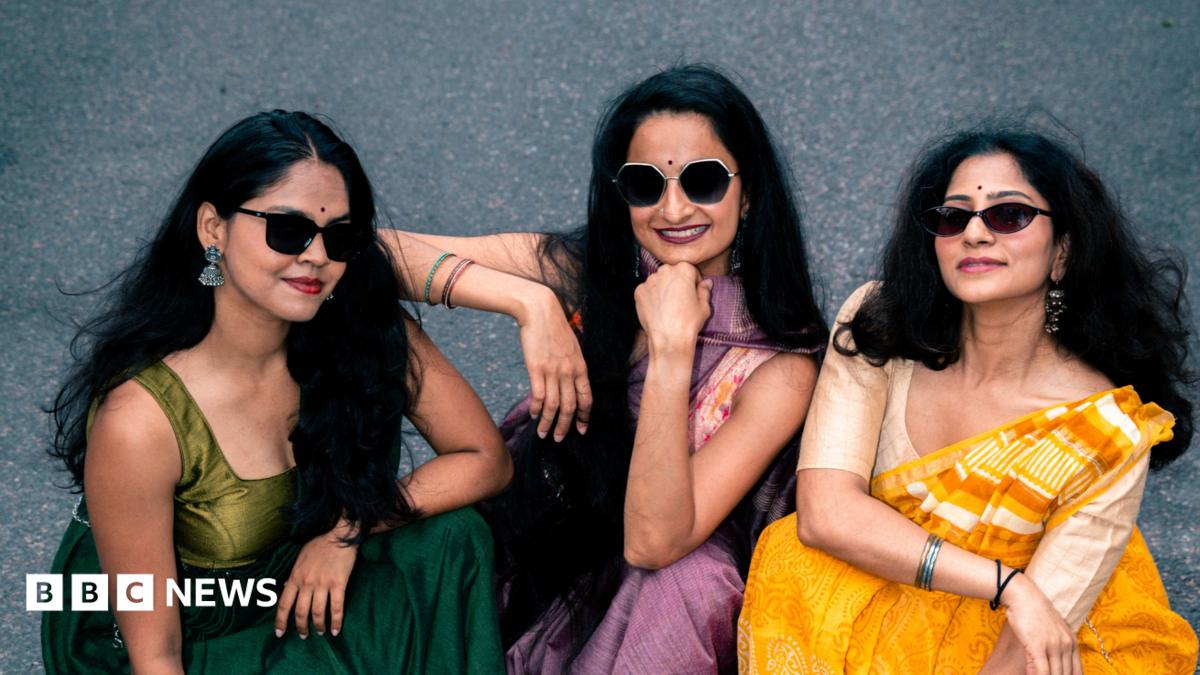

The project will also explore ideas of gender – a topic at the forefront of discourse in India, they say.
Rajendran explains how an advert for a Hindu festival was recently removed from television after controversy over the neckline of a woman’s dress.
Bollywood actor Kriti Sanon was shown celebrating the festival in which sisters tie a thread called Rakhi over their brothers’ wrists, wearing a cropped top, skirt and a cape.
“In India, even at this point, women are being policed over what to wear,” says Rajendran.
“And public media becomes a space where these things really are happening. So then this question of progressiveness and women’s autonomy over their bodies, over their rights – these current and past histories are very relevant in what we are exploring.”
Despite the political influences on Bharatanatyam, Iyer, Rajendran and Semaleesan agree their desire to explore and push the artform is born out of a love for it.
“We thoroughly believe that the form in itself is quite vast. It is traditional for sure, but it’s actually also modern because it allows us that flexibility,” says Semaleesan.
“And we do acknowledge that it has shaped our practice, it has shaped our thinking, it has shaped who we are. And actually, that is the beauty of this art form,” adds Rajendran.
“It is very much out of love that we are doing this. We are asking the questions because we really have grown up with the form. And it has done something to us, essentially, on the way we think, the way we behave, the way we perform.”