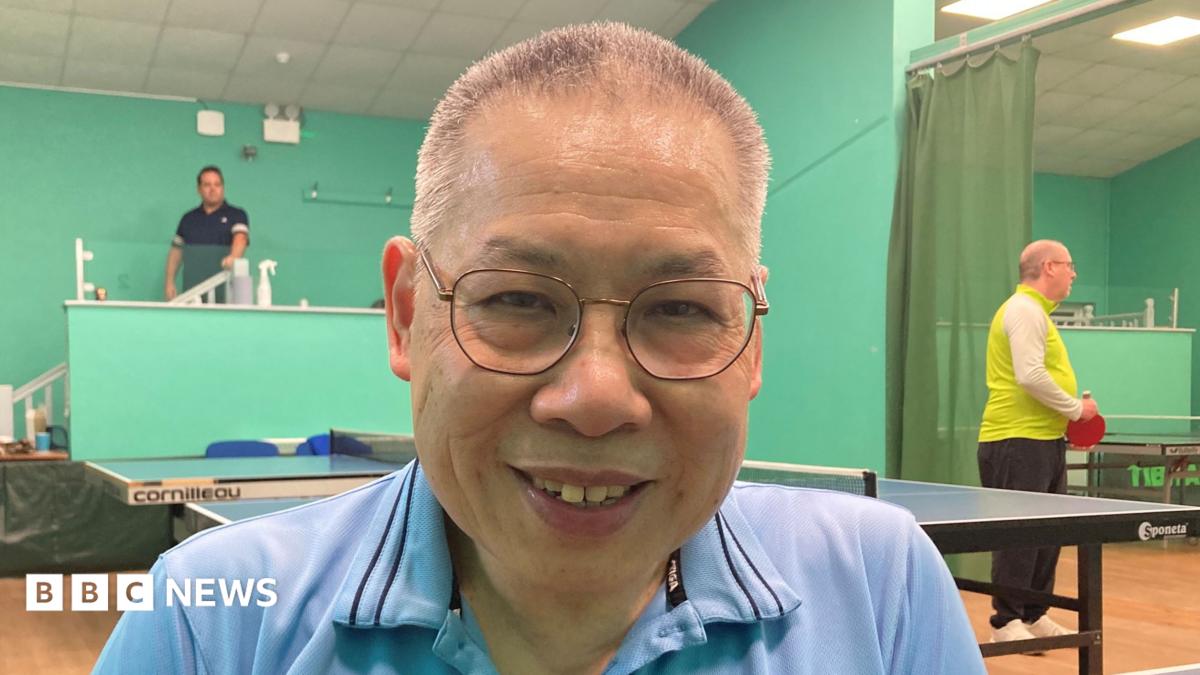

For George Chan, everyday life can feel difficult. Since he was diagnosed with the progressive neurological condition Parkinson’s, he sometimes struggles to tie his shoelaces and cut up food.
“It’s a slightly undignified disease to have,” he says.
“You get quite introverted at times and you lose your confidence.”
But when he plays table tennis, all that melts away.
Chan has played table tennis since he was 18, but it has become more important to him since his diagnosis.
He coaches a twice-monthly table tennis session in Harrogate that caters specifically for people living with Parkinson’s.
And it’s been so successful, there is now a partnership between Parkinson’s UK and Table Tennis England to help other Bat & Chat groups set up across the country.
“I don’t think about the Parkinson’s,” he says.
“The subconscious kicks in and I just see the ball and I chase it down and I hit it.
“The strokes are still there, albeit a bit slow.
“But if people didn’t know I had Parkinson’s, they wouldn’t think I had it when I’m playing table tennis.”
Anna Castiaux, the physical activity programme lead for Parkinson’s UK, says: “Exercise is the only thing that’s been shown to help manage the symptoms of Parkinson’s.
“When you look at the principles of table tennis – balance, moving around the table, side to side – you can see how it links.
“There’s a cognitive element too – making decisions and strategising.
“Sometimes with Parkinson’s, people can become quite rigid in the torso.
“Table tennis makes people do those big movements, and keep them longer.”